Spanish, English, Portuguese, French, German and Japanese. Those are the six languages Fyware Safe lists for its industrial safety simulators, and for a plant in San Luis Potosí that reports to Ohio, Stuttgart, Nagoya or Ulsan, language is a fair first question about VR safety training in Mexico. The harder question comes later, when an inspector from the STPS, Mexico's federal labor ministry, opens the training file. A headset does not answer that one on its own. This guide covers what the simulators practice, why they help and where Mexican rules put the line.
VR safety training in Mexico: what the headset practices
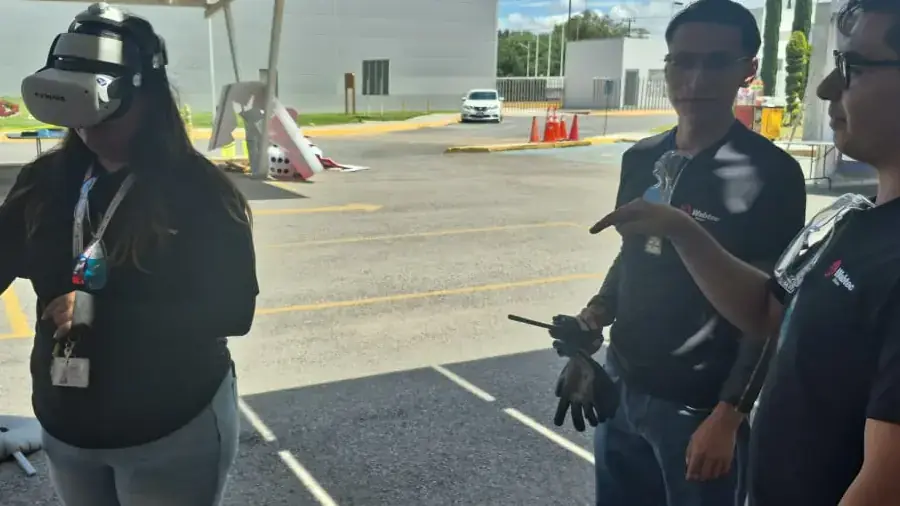
Fyware Safe is Fyware's line of virtual reality simulators for industrial safety. It has three ready modules (fire, personal protective equipment and forklift operation), and all three are generic: none is built around a particular plant's layout or fleet. They run on standalone Meta Quest 3 headsets with no cables, no PC, no accounts and no internet connection.
Each module forces a decision under time pressure:
- Fire. A panel asks the trainee to identify the fire class (A, B, C, D or K) before acting, and a wrong answer costs time. The trainee then runs for the matching extinguisher and controls the fire against the clock, with 2 to 5 fire points in play. The headset scans the room and places the fire and the extinguisher in that same space; if the fire gets out of control, the system orders an evacuation and times the exit.
- PPE. The worker picks and puts on the right equipment by hand from a mixed inventory of good items, damaged items and gear from the wrong industry. A cracked helmet has to be rejected.
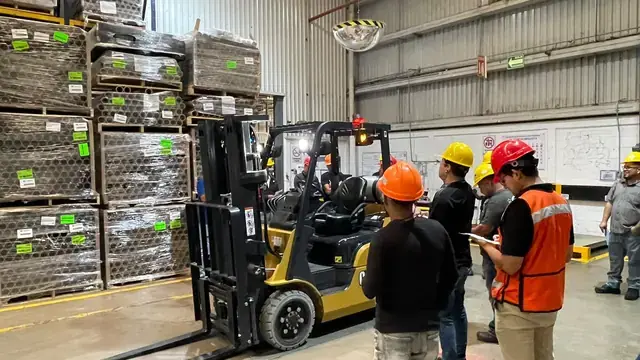
- Forklift. Before touching the wheel, the operator answers four questions about which forklift suits the load. Then come three circuits with three different loads, a voice assistant calling each maneuver, and a pedestrian who crosses without warning at a different point every time. Brake too late and the circuit restarts.
Judge a safety simulator by the decisions it forces a trainee to make while the clock is running.
Why practice in a headset before touching the equipment?
Fyware Safe sums up its pitch as making the mistake in the headset rather than in the aisle, and that is the main argument. A pedestrian stepping in front of a moving forklift is not something a plant can rehearse with a person, and because the crossing point moves on every run, memorizing it does not help. A late brake that would hurt someone in the aisle only costs a restart in the headset.
Repetition is the second argument. Each fire has to be controlled within 1 minute 10 seconds on the clock, and the run restarts at once, with no extinguisher discharged. In a live-fire drill, every unit used goes out for recharge, which NOM-002-STPS-2010, Mexico's fire prevention standard, requires after each use (section 7.19); our guide to fire extinguisher recharge in Mexico covers the rest of that cycle. While the group trains in headsets, the forklifts stay in production.
Then there is the group. In yard practice it is common for one person to discharge the extinguisher while the rest of the group watches. In the PPE module, one headset in rotation handles 15 to 20 people per hour, and the fire and PPE modules need only a clear 2 x 2 m room (about 6.5 by 6.5 ft). The group benefit is that each trainee makes the decision instead of watching someone else make it.
Where does VR fit under Mexico's STPS standards?
Mexico regulates safety training standard by standard, through each NOM (Mexican Official Standard), and Fyware Safe aligns each module with one of them:
| Standard | What it asks of training | Where the headset helps | What stays off the headset |
|---|---|---|---|
| NOM-006-STPS-2023, forklifts | Theory, practical training and an evaluation of knowledge and skills (10.3), refreshed at least every two years (10.4) | Load questions and pedestrian braking; aligned to sections 8.5.2 a) and 10.3, per Fyware Safe | Supervised practice and the skills evaluation on a truck; the written operator authorization |
| NOM-002-STPS-2010, fire | An annual theoretical and practical program (5.8), with hands-on training to operate extinguishers and fight an incipient fire (11.2) | Fire class recognition and extinguisher choice | Discharge technique on a controlled live fire |
| NOM-017-STPS-2024, PPE | Theory plus hands-on training before new hires start, refreshed at least every two years (5.9) | Choosing, inspecting and donning PPE | The plant's own PPE, set by its signed hazard analysis per job and area (5.1), since there is no official list |
For a US reference point only: OSHA's forklift rule, 29 CFR 1910.178(l), lets formal instruction include interactive computer learning and still requires practical training and an evaluation of performance in the workplace. NOM-006-STPS-2023 is a separate legal regime, and its chapter 15 states that it is not equivalent to any international standard. If your corporate program treats computer-based modules as classroom support, give VR that same role in Mexico and build the file on Mexican documents. Our guide to Mexico forklift regulation NOM-006 compares both rules in more detail.
What a VR simulator does not replace in Mexico
Fyware Safe publishes its own limits, which makes the vendor conversation easier. The simulator:
- Does not certify or authorize operators. NOM-006-STPS-2023 lets only trained personnel authorized by the employer operate a forklift (section 8.5.2), and that written authorization stays with your plant.
- Does not replace the DC-3, Mexico's certificate of labor skills under article 153-V of the Federal Labor Law, or the external training agent registered with the STPS who issues it.
- Does not replace supervised practice on the equipment.
- Is not compliance evidence for an audit or an inspection.
- Does not record who did the exercise. Fire and PPE results stay inside the headset, and the forklift module exports results as a local CSV file.
The simulated warehouse and its counterbalanced forklift are also generic, so they are not your aisles or your fleet. What an inspector reads is the training log required by section 10.5 of NOM-006-STPS-2023, the DC-3s and the signed authorizations. Use the headset to prepare operators for the truck, and keep the evaluation on the trucks your plant runs. Our guide to online forklift certification in Mexico applies the same reasoning to online courses.
Six languages in the headset, Mexican paperwork on file
Fyware Safe sets the language at implementation, so confirm it before the session is scheduled. For a multinational plant the choice matters in two directions. Operators on the floor train in the language they work in, and a corporate EHS team can review a module in its own language when the headsets are set up that way.
The paperwork does not follow the headset. NOM-017-STPS-2024 already requires PPE instructions in Spanish or in the language the worker speaks (section 7.2), and the DC-3, the training log and the operator authorization are Mexican documents built on Mexican standards. The headset can speak your team's language, while the compliance file has to speak Mexico's.
How does SIISA use VR inside a DC-3 course?
The technology belongs to Fyware. SIISA Consultores uses Fyware Safe simulators as support inside its DC-3 courses, in this order:
- Theory with the instructor.
- VR simulator, to practice the decision and the mistake before touching the equipment.
- Supervised practice on the equipment: the forklift, an extinguisher on a controlled fire, or the PPE itself.
- Evaluation of knowledge and skills.
- DC-3 for each trainee who passes, delivered the same day as the course.
The sequence applies to the forklift, fire extinguisher and brigade, and PPE courses listed on the DC-3 safety training page for plants in San Luis Potosí. SIISA issues DC-3 certificates under the external training agent registration of its lead instructor, and it is listed in the REPSE, Mexico's federal registry of specialized service providers, under folio 325941, valid through August 7, 2028, for industrial training. Before signing a purchase order, ask any provider where the headset sits in that sequence and who issues the DC-3.
Frequently asked questions
Does VR training count toward a DC-3 in Mexico?
The DC-3 goes to a worker who passes a course through its evaluation (STPS training agreement, DOF June 14, 2013, article 24), and a simulator can be one part of that course. Fyware Safe states that its simulators do not replace the DC-3 or the external training agent registered with the STPS.
Is VR accepted as hands-on forklift training under NOM-006?
Not on its own. Section 10.3 of NOM-006-STPS-2023 requires practical training and an evaluation of knowledge and skills, and Fyware Safe states that its simulator does not replace supervised practice on the equipment. Use it as a rehearsal before the truck.
What does a plant need to run the VR simulators?
Standalone Meta Quest 3 headsets, with no cables, PC, accounts or internet connection. The fire and PPE modules run standing in any clear 2 x 2 m room, and the forklift module runs seated, with a steering wheel, pedals, reverse and a fork lever.
Which languages do the VR safety simulators support?
Fyware Safe lists Spanish, English, Portuguese, French, German and Japanese, with the language set at implementation. The DC-3, the training log and the operator authorization remain Mexican documents whatever language the headset uses.