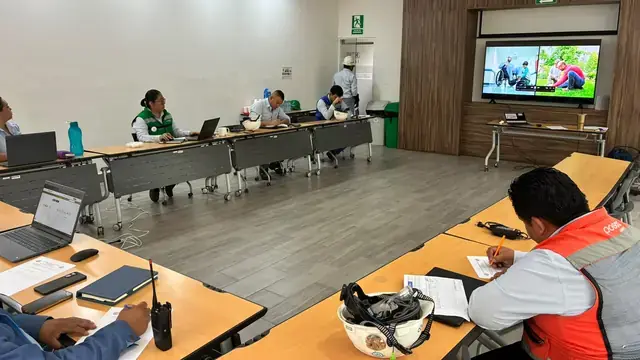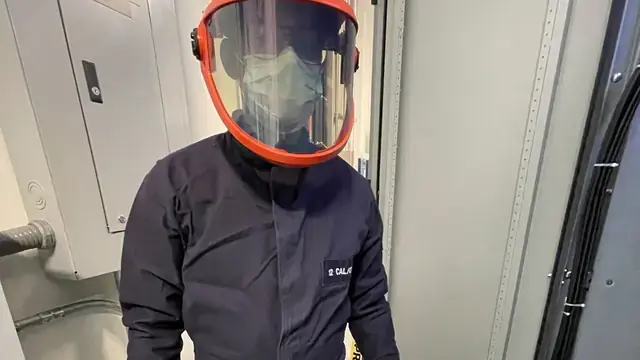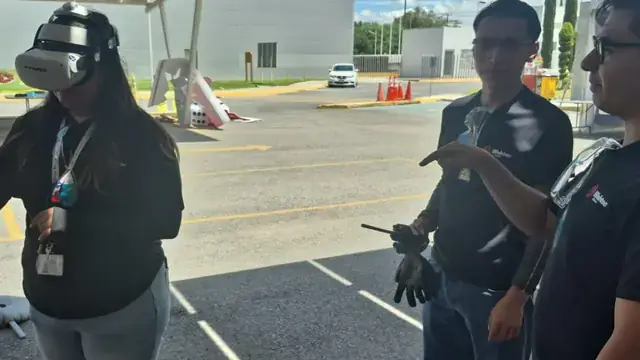
"This Mexican Official Standard is not equivalent to any international standard." Chapter 15 of NOM-006-STPS-2023 says it in one sentence (our translation), and it is the first thing a manager coming from an OSHA-based operation should know about the Mexico forklift regulation NOM-006. Your corporate forklift program is a solid base. It will not, by itself, show an inspector from the STPS, Mexico's federal labor ministry, that your plant meets a text with its own equipment list, its own refresher cycle and its own records.
Mexico forklift regulation NOM-006 at a glance
| Item | Detail |
|---|---|
| Full key | NOM-006-STPS-2023 |
| Subject | Storage and handling of materials using machinery: workplace safety conditions |
| Published | DOF (Mexico's official gazette), March 7, 2024 |
| In force | 180 calendar days later: September 3, 2024 |
| Replaced | NOM-006-STPS-2014, void from that date |
| Machinery covered | Hoists, winches, forklifts, cranes, conveyors and front loaders (section 4.17) |
| Enforced by | STPS (chapter 13) |
| Third-party inspection | Optional for the employer (section 11.1) |
NOM stands for Norma Oficial Mexicana, a mandatory federal technical standard. This one started as a 2017 draft and was ratified by the national standards committee in 2023, according to its preamble.
What changed from the 2014 version?
We compared both texts as published in the DOF. These are the changes that reach the plant floor:
- Scope. The superseded 2014 standard covered materials handled with machinery or by hand. The 2023 version covers machinery only, and manual handling of loads falls under NOM-036-1-STPS-2018, which the new text lists in its bibliography.
- Medical surveillance. The 2014 chapter on pre-employment exams, annual follow-up and five-year medical files for manual handlers is gone.
- Contractors. The employer must now supervise that contractors handling materials on site comply with the standard (5.5).
- Operators. Workers may operate only machinery they were trained and authorized for (6.5). In 2014 it appeared only in the measures for specific equipment, such as cranes and forklifts, not among worker duties.
- Forklifts. Overhead protection is required regardless of lift height, where 2014 required it above 1.80 meters. Seat belts must be retractable, and the truck must show its maximum load capacity and tire pressure (8.5.1).
- Refresher triggers. The 2014 text required early retraining after an accident, unsafe operation or a poor evaluation. The 2023 text keeps only new machinery and changed procedures or operating areas (10.4).
Keep retraining after accidents as plant policy, because the 2023 text dropped that trigger without forbidding it.
The training format itself did not change: theory, practical training and evaluation, with the same seven content areas (section 11.4 in 2014, 10.3 in 2023).
Equipment checklist for every forklift in the plant
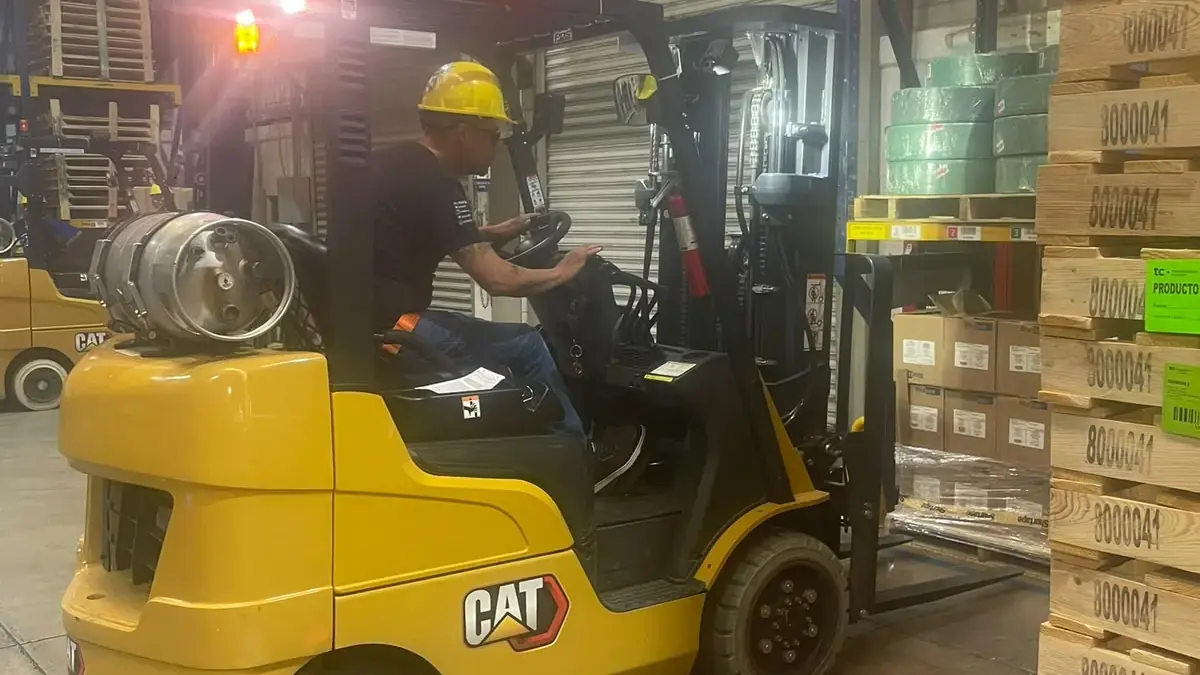
Section 8.5.1 lists what each truck must have:
- A cab that protects against falling objects and weather, with good visibility, a rear-view mirror, easy access, a non-slip floor, ventilation, a seat with a retractable seat belt and fire-resistant materials.
- A horn and an automatic reverse alarm.
- Marked maximum load capacity and tire pressure.
- An amber flashing or rotating beacon that works while the truck moves, placed so it does not dazzle the operator.
- Front and rear lights.
The operating rules in 8.5.2 cover trained and authorized operators only, seat belts on, no loads above the manufacturer's plate rating, forks traveling 0.15 to 0.20 meters above the floor, posted speed limits, barriers at docks, refueling or battery charging in ventilated areas with fire equipment at hand, and parking with forks on the floor and the ignition off. Trucks with anomalies come out of service (8.5.3).
The text makes no distinction between owned and rented trucks. Inspect rented units against the same list on delivery, since the standard does not exempt them.
How does NOM-006 training compare with OSHA?
This table is a general reference for managers used to US rules. Meeting one set of rules does not demonstrate compliance with the other.
| Topic | NOM-006-STPS-2023 (Mexico) | 29 CFR 1910.178 (US OSHA) |
|---|---|---|
| Format | Theory, practical training and evaluation of knowledge and skills (10.3) | Formal instruction, practical training and evaluation of performance in the workplace ((l)(2)(ii)) |
| Periodic requirement | Refresher training at least every 2 years (10.4) | Performance evaluation at least every 3 years ((l)(4)(iii)) |
| Early triggers | New machinery, changed procedures or operating areas | Unsafe operation, accident or near miss, poor evaluation, different truck type, changed workplace conditions ((l)(4)(ii)) |
| Record | Log with name, position, date, topics, instructor and STPS registration number if any (10.5), plus the DC-3 | Employer certification with operator name, training and evaluation dates and trainer or evaluator ((l)(6)) |
Run the Mexican plant on the two-year cycle, because a three-year US evaluation schedule leaves a gap under NOM-006.
Can forklift training be done online in Mexico?
Searches for "dc3 en línea" (online DC-3) grew 900% year over year, with 100 to 1,000 searches a month in Mexico (Google Ads Keyword Planner, September 2025 to August 2026). The sites that serve that demand, reviewed in September 2026, charge MXN 100 to 1,000 per course and issue the certificate after an online test.
Section 10.3 requires practical training and an evaluation of skills. An online exam can cover the theory, while the practice and the skills evaluation have to happen on a truck.
Who issues, signs and reports the certificate is covered in our guide to the DC-3 certificate in Mexico.
Building a NOM-006 file for a plant in San Luis Potosí
San Luis Potosí has 448 manufacturing plants with 51 or more employees (INEGI, Mexico's national statistics institute, May 2026), and its injuries are more severe than average: 3.33 permanent disabilities per 1,000 workers in 2025, against 2.10 nationally, according to the 2025 statistical report of the IMSS (Mexican Social Security Institute). Nationwide, 48.2% of work accidents and illnesses happen to people with less than a year in their job (IMSS, 2025), which is why the induction course in section 10.1 deserves attention.
A complete NOM-006 file for a plant with forklifts includes:
- An inventory of material-handling machinery, rented units included.
- A review and maintenance program with execution records (7.1 and 5.10).
- Procedures for installation, operation, maintenance and emergencies (7.2 to 7.6).
- Written operator authorizations, since the conformity assessment procedure asks for documentary evidence.
- The training log and the DC-3s for passed courses (10.3 to 10.5).
- Documented supervision of contractors that handle materials on site (5.5).
- PPE under NOM-017-STPS-2024, which superseded the 2008 version the standard cites.
- A first-aid manual for material-handling risks (5.7).
SIISA Consultores offers forklift rental in San Luis Potosí, with 1.5-ton trucks from MXN 2,800 per day, 7-ton trucks from MXN 5,200 per day and freight from MXN 1,200, plus VAT. Forklift courses with hands-on practice are part of its DC-3 safety training.
Frequently asked questions
Is NOM-006-STPS-2014 still in force?
No. It became void when NOM-006-STPS-2023 took effect, 180 calendar days after its publication in the DOF on March 7, 2024. Since September 2024, procedures, training logs and certificates should cite the 2023 version.
Which DC-3 courses does a forklift operator need in Mexico?
NOM-006-STPS-2023 requires theory, practical training and a skills evaluation for operators, helpers, installers and maintenance staff (section 10.3), plus an induction course for new hires (10.1). The DC-3 is the evidence that each worker passed, and the training must be refreshed at least every two years.
How much is the fine for not complying with NOM-006?
Mexico's Federal Labor Law fines employers that do not observe safety and health standards 250 to 5,000 UMA (Mexico's daily unit of measure for fines) per affected worker (arts. 992 and 994, section V). At the 2026 UMA of MXN 117.31, that is MXN 29,327.50 to 586,550 per worker, with the exact amount set by the authority.