Published: March 28, 2025, in the Diario Oficial de la Federación (DOF), Mexico's federal gazette. In force: September 28, 2025. Replaces: NOM-017-STPS-2008. Issuer: the STPS, Mexico's federal labor ministry, as a Mexican Official Standard (NOM). That is the spec sheet for the current Mexico PPE standard NOM-017-STPS-2024. If your plant in San Luis Potosí runs a PPE program written at headquarters in Ohio, Stuttgart, Nagoya or Ulsan, this is the text a Mexican labor inspector will hold it against, line by line.
What changed in the Mexico PPE standard NOM-017-STPS-2024?
We compared the 2008 and 2024 texts as published in the DOF. The scope is unchanged, the obligations grew, and these are the changes a global program is most likely to miss:
| Topic | NOM-017-STPS-2008 (replaced) | NOM-017-STPS-2024 |
|---|---|---|
| Hazard analysis | Five data points per job (5.2) | Adds company name, address, date, areas, four hazard families and the analyst's name and signature (5.1) |
| PPE certification | Not among employer duties | Certificate from an accredited and approved body when a Mexican product standard exists (5.4) |
| Training | Per manufacturer instructions, no cycle (5.6) | Theory plus hands-on, before new hires start, refreshed at least every two years (5.9) |
| Visitors and emergencies | Optional use of the guide tables for visitors (5.3) | PPE on hand for visitors and for emergency response (5.5) |
| Issue records | Not required | Inspection, replacement, cleaning, maintenance and disposal, signed by the worker (5.12) |
The six-month transition ended on September 28, 2025, and the 2008 version has had no effect since then (third transitory article). Any corporate PPE procedure that still cites NOM-017-STPS-2008 is out of date in Mexico, whatever its global revision date says.
A signed hazard analysis for every job and area
Section 5.1 asks the employer to identify and analyze hazards for each job and each area of the workplace, and to keep the record current whenever equipment or processes change. The record names the legal entity and its address, the date, the activities and jobs assessed, the body regions exposed, the workers who must receive PPE, and the person who did the analysis, with a signature.
Hazards are grouped in four families: physical (noise, vibration, lighting, radiation, extreme temperatures and, explicitly, electrical hazards), mechanical, chemical and biological. If your corporate program already uses job hazard assessments, the logic will feel familiar. The difference is format. The Mexican record has its own required fields, and the inspection procedure checks them one by one (section 9.3). A global PPE matrix becomes evidence in Mexico once it is tied to named jobs, named areas and a signature.
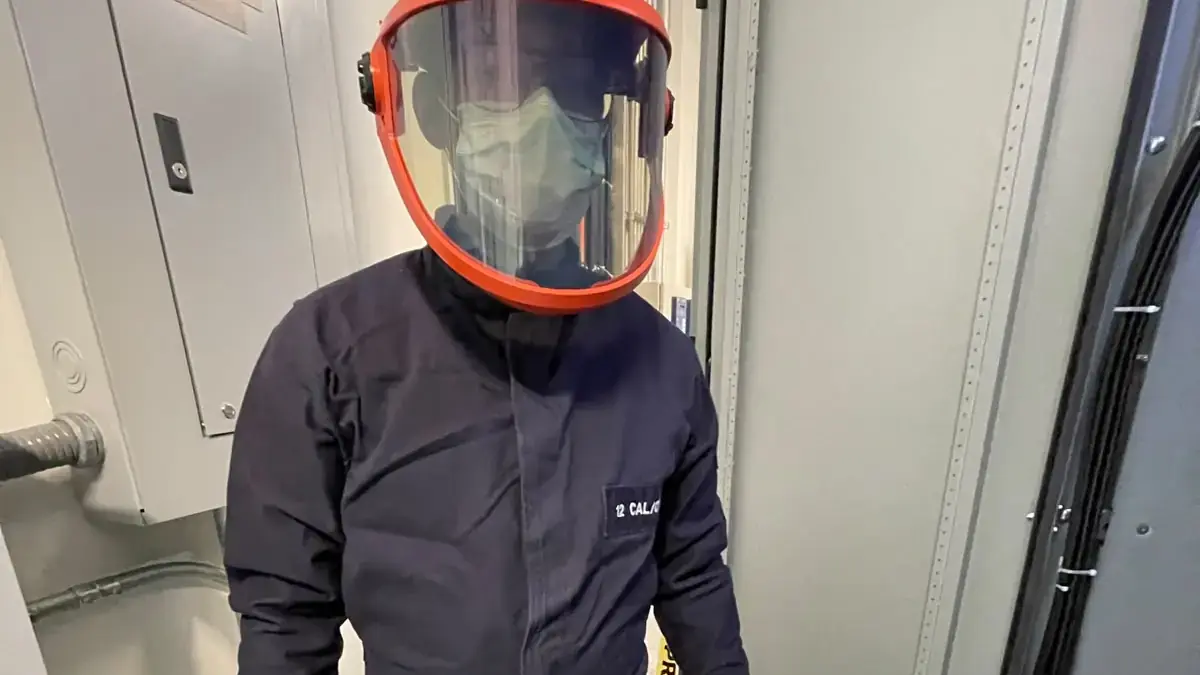
Section 5.2 treats PPE as a temporary, complementary or backup measure next to other controls. Section 5.3 adds fit and compatibility with glasses, hearing aids and prostheses, and rules out sharing gloves, footwear, masks, earplugs and protective clothing that counts as PPE. The arc flash suit in the photo belongs to one technician.
Does imported PPE need Mexican certification?
Section 5.4 is new. Once the hazard analysis and PPE selection are done, the employer verifies that the PPE it buys carries a certificate from a certification body accredited and approved under Mexico's Quality Infrastructure Law (Ley de Infraestructura de la Calidad), whenever a NOM exists for that equipment. The standard itself references three product NOMs: protective footwear (NOM-113-STPS-2009), helmets (NOM-115-STPS-2009) and particulate respirators (NOM-116-STPS-2009).
Where no product NOM exists, the employer looks for certification under Mexican standards (NMX) or applicable technical standards and, failing those, for manufacturer data on the protection level and the conditions under which the equipment stops protecting. A US or EU mark on the box does not, by itself, show that a Mexican-accredited body certified the product. Global sourcing saves money in Mexico only if the Mexican certificate travels with the shipment.
Spanish instructions and a two-year training cycle
Under sections 7.1 and 7.2, PPE instructions must be in Spanish or in the language the worker speaks, and available for workers to consult. They must say when to discard PPE, including after an impact or an electrical discharge. Contaminated protective clothing is decontaminated and washed at the workplace or by a specialized service, never at the worker's home. An English-only PPE manual on a Mexican shop floor is a documented gap, however good the equipment is.
Training follows section 5.9: theory plus hands-on practice, delivered to new hires before they start, and refreshed at least every two years, or sooner if the PPE or the working conditions change. The record lists participants, date, topics and the instructor's STPS training agent number where one applies. New hires justify the urgency: 48.2% of work accidents and occupational illnesses in Mexico happen to people with less than a year in the job (IMSS, the Mexican Social Security Institute, Statistical Report 2025, table VII.12).
The evidence is the DC-3, Mexico's certificate of labor skills, when the course covers the standard's content. The trainer can be the PPE manufacturer, someone it authorizes or a training agent registered with the STPS. Our guide to the DC-3 certificate in Mexico explains who signs it, and the DC-3 safety training page lists courses by standard.
Where do contractors and visitors fit in the PPE rule?
Section 5.5 requires PPE on hand for visitors who enter mandatory-PPE areas, such as suppliers, inspectors, auditors and buyers. That list covers your corporate auditors and the customer quality team that flies in for a launch. The same section requires PPE for emergency response, in enough quantity for the plant's emergency plans.
For contractors, the 2024 text puts supervision on the host employer. The plant makes sure workers from contractors for specialized services or works know the hazards and the PPE required (5.8), and checks during the shift that they wear it (5.10). These are the same specialized contractors that Mexico's Federal Labor Law (articles 13 to 15) requires to be listed in the REPSE, the federal registry of specialized service providers.
What an STPS inspector checks, and what it costs
The inspection combines document review, a walk through the plant and interviews with workers chosen at random: one interview up to 15 workers, two up to 50, three up to 105, and above that one per 35 workers, capped at 15 (9.4). Records can be printed or electronic and must be kept at least one year (9.5). A voluntary third-party inspection report stays valid for two years (8.4).
Mexico's Federal Labor Law fines failure to follow safety standards at 250 to 5,000 UMA (article 994, section V). The UMA is Mexico's daily unit of measure for fines, MXN 117.31 in 2026, so the range is MXN 29,327.50 to 586,550, applied per affected worker (article 992). Budget the exposure per worker, because that is how the law counts a PPE gap.
The penalty math is in our guide to STPS fines in Mexico, and a gap review against the whole standard is part of STPS compliance consulting.
Frequently asked questions
Is NOM-017-STPS-2008 still in force?
No. It lost effect on September 28, 2025, when NOM-017-STPS-2024 took effect after its publication in the DOF on March 28, 2025. Procedures, PPE matrices and training materials that cite the 2008 version should be updated.
How often must PPE training be refreshed in Mexico?
NOM-017-STPS-2024 requires PPE training to be reinforced at least every two years, or sooner when the PPE changes or working conditions affect its use (section 5.9). New hires must be trained before they start work.
Does a DC-3 count as PPE training evidence?
Yes, when the course covers the content of NOM-017-STPS-2024, the DC-3 is the evidence the standard's inspection procedure asks for. The training can come from the PPE manufacturer, a trainer it authorizes, or a training agent registered with the STPS.
What does the STPS check on PPE during an inspection?
Inspectors review documents, walk the floor to confirm PPE use and signage, and interview a random sample of workers. The sample ranges from one worker at sites with up to 15 people to a maximum of 15 interviews (section 9.4).