One extinguisher per 300 m² (about 3,200 sq ft) of floor in ordinary fire-risk areas, one per 200 m² (about 2,150 sq ft) in high-risk areas, and the top of each unit no higher than 1.50 m (about 5 ft) above the floor. Those placement rules sit in numeral 7.17 of NOM-002-STPS-2010, the Mexican Official Standard (NOM) on fire prevention issued by the STPS, Mexico's federal labor ministry. Fire extinguisher recharge in Mexico also runs on a second standard, NOM-154-SCFI-2005, issued by the Ministry of Economy, and a plant has to satisfy both.
How often is fire extinguisher recharge required in Mexico?
NOM-002-STPS-2010 sets no single recharge interval. Numeral 7.18 requires maintenance at least once a year, guaranteed under NOM-154-SCFI-2005, and numeral 7.19 requires recharge after every use and whenever maintenance calls for it. The standard defines maintenance (numeral 4.19) as a complete internal and external review that includes agent recharge when required.
| Task | Frequency | Source |
|---|---|---|
| Inspection of each unit | Monthly, under an annual program | NOM-002-STPS-2010, 7.2 |
| Written inspection record | Every monthly inspection | NOM-002-STPS-2010, 7.3 |
| Maintenance | At least once a year | NOM-002-STPS-2010, 7.18 |
| Recharge | After every use, or when maintenance requires it | NOM-002-STPS-2010, 7.19 |
| Hydrostatic test, stored-pressure water, CO2 and dry chemical | At least every five years, or sooner if the tank is struck | NOM-154-SCFI-2005, 5.6 |
Plan on three recharge triggers: the annual service, any discharge and any defect found in a monthly check. For plants in San Luis Potosí, SIISA Consultores receives, recharges and returns extinguishers from 1 to 50 kg through its fire extinguisher service.
Monthly inspections under NOM-002-STPS-2010
Under numeral 7.2, each monthly check confirms that the unit is where the site plan places it, visible, signposted and unobstructed, with its tamper seal intact. Stored-pressure gauges must read in the green zone and CO2 units must hold their rated capacity. The person inspecting also looks for corrosion, leaks, dents and damaged hoses, nozzles or levers, and confirms the label is legible and current. A damaged unit that cannot be repaired is replaced with one of the same characteristics.
Numeral 7.3 requires a written record of each inspection with date, inspector, results, anomalies and follow-up, and numeral 5.12 requires showing those documents when the labor authority asks.
If a global inspection app logs your checks, it has to produce a record that matches numeral 7.3 field by field.
What changes from an OSHA-style annual check?
If your corporate fire standard was written around US federal rules, compare the texts before assuming a global contract covers your Mexican site. The table is a general reference only, not a claim of legal equivalence.
| Topic | Mexico: NOM-002-STPS-2010 and NOM-154-SCFI-2005 | US reference: OSHA 29 CFR 1910.157 |
|---|---|---|
| Routine check | Monthly inspection under an annual program, with a written record (7.2, 7.3) | Monthly visual inspection of portable units, (e)(2) |
| Maintenance | At least once a year (NOM-002, 7.18) | Annual maintenance check, (e)(3) |
| Internal examination | Generic procedures always consider emptying the agent and inspecting the cylinder inside (NOM-154, 5.6) | Not required for stored-pressure units at the annual check, (e)(3) |
| Unit out for service | Replace it in the same location with one of at least the same type and capacity (NOM-002, 7.18) | Provide alternate equivalent protection, (e)(5) |
NOM-154 lists NFPA 10 in its bibliography and declares partial concordance with ISO 11602-2, so the vocabulary will feel familiar. A service contract written for another country should be checked line by line against NOM-154 before it is applied in Mexico.
The service label and the dry chemical collar
After each service, numeral 7.2 l) of NOM-002 requires the label to show the provider's name, address and phone; nominal capacity in kilograms or liters and the agent; brief operating instructions with figures; the fire class and any contraindications; the official compliance mark under NOM-106-SCFI-2000; the month and year of the last maintenance; and the NOM-154-SCFI-2005 mark with the provider's compliance ruling (dictamen) number.
Dry chemical units also carry the NOM-154 collar, a ring on the cylinder neck that cannot come off without opening the extinguisher and shows the service month and year and the verification unit's hologram. Brand-new units are exempt from the service-date, NOM-154 mark and collar checks.
A label missing the NOM-154 mark or the dictamen number fails numeral 7.2 l) of NOM-002 on its own.
Who is allowed to service extinguishers in Mexico?
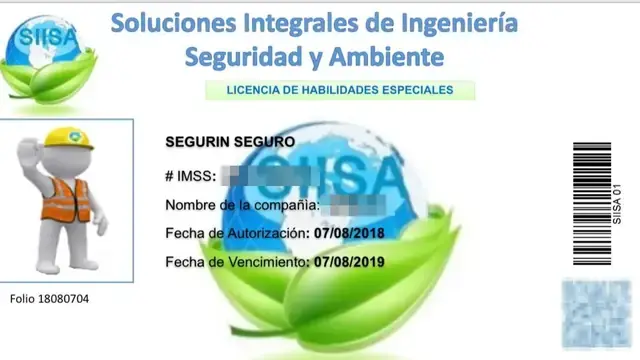
NOM-002 defines the extinguisher service provider as a person or company verified against NOM-154-SCFI-2005 by an accredited and approved conformity assessment body (numeral 4.25). Under NOM-154, technicians must be trained in written procedures and hold a DC-3, Mexico's official record of job skills training under Article 153-V of the Federal Labor Law (numeral 5.4).
The provider guarantees each serviced unit for at least one year while the seal stays intact (5.6.7). Before signing with any provider, local or global, ask for the dictamen number that will appear on your labels and for a plan to cover empty locations while units are out, as numeral 7.18 requires.
Placement rules: area, travel distance and height
Fire risk, ordinary or high, comes from Appendix A of NOM-002 (numeral 5.1). Numeral 7.17 pairs the area ratio and the 1.50 m height limit with a maximum travel distance to an extinguisher, counting turns and detours, set in table 1:
| Fire risk | Classes A, C and D | Class B | Class K |
|---|---|---|---|
| Ordinary | 23 m (about 75 ft) | 15 m (about 49 ft) | 10 m (about 33 ft) |
| High | 23 m (about 75 ft) | 10 m (about 33 ft), or 15 m if wheeled | 10 m (about 33 ft) |
Areas with automatic suppression may carry half the required units if each holds at least 6 kg or 9 liters (numeral 7.17, item e).
Training and fire brigades the STPS expects
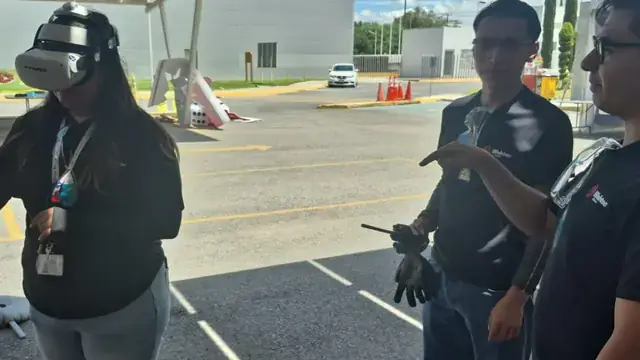
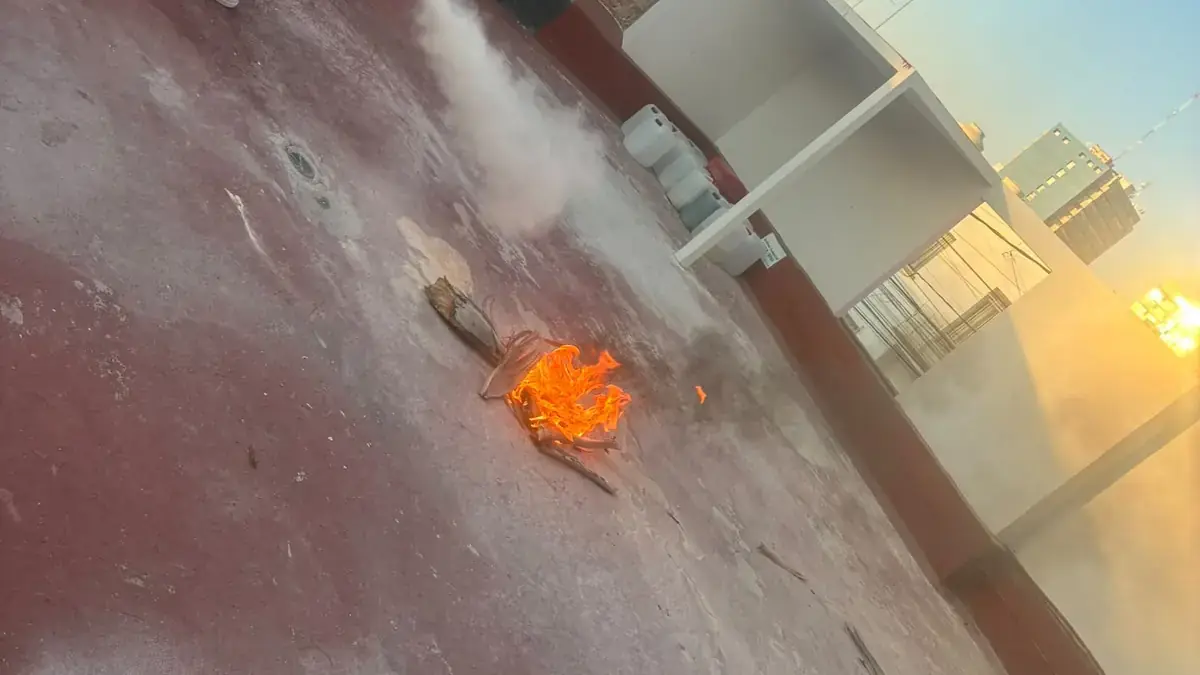
NOM-002 requires an annual theoretical and practical training program (numeral 5.8) that includes hands-on training to operate extinguishers and fight an incipient fire (11.2). High fire-risk sites must have fire brigades (5.6), whose members also train on the use and maintenance of firefighting equipment (11.3).
Live-fire practice is the part of NOM-002 training that an online course cannot deliver. Extinguisher and brigade courses with a DC-3 are part of our DC-3 safety training in San Luis Potosí.
Failing to observe safety standards carries fines of 250 to 5,000 UMA, Mexico's daily unit of measure for fines, per affected worker; our guide to STPS fines in Mexico shows the peso amounts.
Frequently asked questions
What does NOM-002-STPS-2010 require for fire extinguishers?
It requires an annual program of monthly inspections with written records (numerals 7.2 and 7.3), maintenance at least once a year and recharge after every use, both guaranteed under NOM-154-SCFI-2005 (7.18 and 7.19). It also sets how many units to install, the maximum travel distance to reach one and a maximum mounting height of 1.50 m (7.17).
How often does the standard require extinguisher training?
NOM-002-STPS-2010 requires an annual theoretical and practical training program that includes operating extinguishers (numerals 5.8 and 11.2). Fire drills are required at least once a year at ordinary-risk sites and twice a year at high-risk sites (5.7).
How much is the STPS fine for not complying with NOM-002?
Article 994, section V, of Mexico's Federal Labor Law sets fines of 250 to 5,000 UMA for failing to observe safety standards, which is MXN 29,327.50 to 586,550 with the 2026 UMA of MXN 117.31. The fine applies per affected worker under Article 992, and the authority sets the final amount.