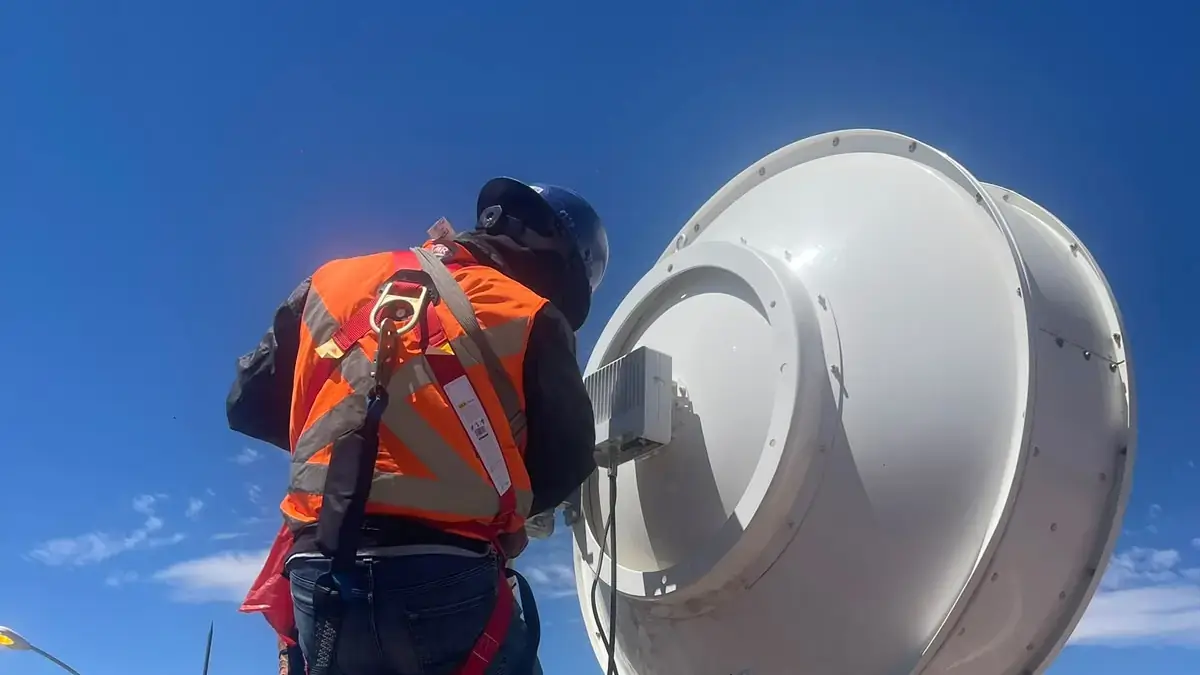
1.80 m above the reference level, about 5 ft 11 in. Any maintenance, installation, cleaning or operating task above that line counts as work at heights in Mexico under NOM-009-STPS-2011, the mandatory standard (NOM, Norma Oficial Mexicana) issued by the STPS, Mexico's federal labor ministry. For a plant in San Luis Potosí that services mezzanines, roof units or overhead lighting, most of that work is already inside the standard.
The standard was published in the DOF, Mexico's Official Gazette, on May 6, 2011, and replaced NOM-009-STPS-1999, which only covered suspended access equipment. It is still the current version.
What counts as work at heights in Mexico?
Section 4.33 defines it as maintenance, installation, demolition, operation, repair or cleaning activities performed more than 1.80 m above the reference level, plus the risk of falling through floor openings such as pits and shafts. Section 2 applies the standard to every workplace where that work happens. There is no headcount threshold and no industry carve-out.
Chapters 7 to 13 set general measures and specific conditions for harness systems, scaffolds, aerial lifts, ladders and safety nets. If your corporate fall protection standard was written around OSHA, the hardware logic will look familiar. The differences sit in the paperwork: manuals and procedures must be in Spanish (section 5.2), and several records have contents fixed by the standard. Use your global fall protection standard as a starting point and map it section by section against NOM-009.
The signed permit required before anyone goes up
Section 7.2 sets the core rule: only personnel trained and authorized by the employer may work at heights. Each authorization must list:
- the authorized worker's name;
- the type of work and the area where it takes place;
- the safety measures, based on the hazards found in the pre-job analysis of the area (section 5.1);
- the start date and time and the estimated duration;
- the name and signature of the employer or the person designated to authorize.
Section 5.3 requires that authorization in writing for tower scaffolds, suspended scaffolds and aerial lifts, and it can only be issued once the safety measures are confirmed in place. A global permit-to-work form covers NOM-009 only if it captures every field listed in section 7.2.
Section 5.15 obliges the employer to show these records, along with the emergency and rescue plan (chapter 15), to the labor authority on request.
How does NOM-009 treat scissor lifts and boom lifts?
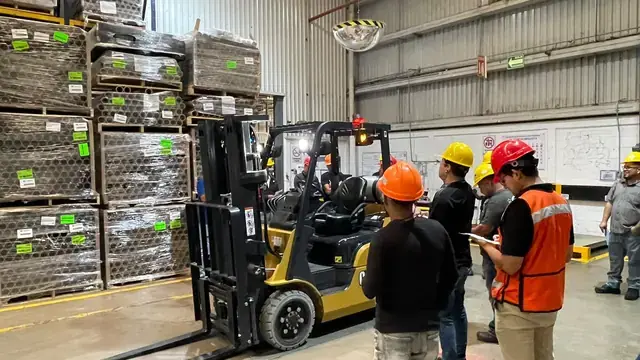
Section 16.5 ties aerial lift training to the machine. It must cover the specific use of the model to be operated, at the workplace or in similar conditions; the manufacturer's training program; safety, operation and inspection of that equipment; fall arrest use and the emergency plan; and a theory and practical evaluation.
A certificate earned elsewhere covers the lift on your floor only if it included that model under comparable conditions. In Mexico, aerial lift training follows the model, so a new model on site calls for new training.
Chapter 11 adds equipment conditions: a basket with side protection at least 90 cm (about 35 in) high and an anchorage point for the harness (11.2), operating and maintenance manuals in Spanish (11.1), and a visual and functional check of controls, safety devices and stabilizers at the start of every shift (11.3).
When you rent, those requirements travel with the machine: confirm the model and get the Spanish manual before scheduling training. SIISA's aerial lift rental in San Luis Potosí lists a vertical mast lift (30 ft, 230 kg) from MXN 1,800 per day, a 30 ft scissor lift from MXN 3,500 and a 30 ft telescopic boom from MXN 3,800, plus IVA, Mexico's value-added tax. For equipment choice, see scissor lift vs boom lift for plant maintenance.
Medical exams, inspections and record retention
| Requirement | Frequency or retention | Section |
|---|---|---|
| Medical exam for workers at heights | At least once a year | 5.10 and 14.1 |
| Latest medical exam on file | While the worker stays on work at heights | 14.3 |
| Inspection of systems and equipment | Yearly, or the manufacturer's interval if shorter | 7.14 |
| Inspection and maintenance records | Kept at least one year | 5.8 |
| Aerial lift visual and functional check | Start of every shift | 11.3 |
| Training refresher | No interval set | Chapter 16 |
Each exam record must carry the worker's name, the medical evaluation, and the physician's name, signature and cédula profesional, Mexico's professional license number (section 14.2). Workers, in turn, must report any health condition or acrophobia that could compromise safety (6.5). Those results are sensitive personal data under Mexican privacy law; our guide on pre-employment medical exams in Mexico covers how to handle them.
The last row needs a decision from your side. Because NOM-009 sets no refresher interval, write your own into the annual training plan and apply it at every site.
What happens if an STPS inspector finds gaps?
Mexico's Federal Labor Law (LFT) sets a fine of 250 to 5,000 UMA for an employer that fails to observe safety and hygiene standards (art. 994, section V). The UMA is Mexico's daily unit of measure for fines; at the 2026 value of MXN 117.31, the range runs from MXN 29,327.50 to 586,550. Under article 992, when one omission affects several workers, a fine applies for each of them.
The second cost arrives through the IMSS, the Mexican Social Security Institute. In the work risk premium formula (Social Security Law, art. 72), temporary disability days are divided by 365 while each permanent disability is multiplied by 28. San Luis Potosí recorded 3.33 permanent disabilities per 1,000 workers in 2025, against 2.10 nationwide (IMSS, Memoria Estadística 2025, the institute's statistical report).
Contractors, DC-3 records and who issues them
Hiring out the job does not move the obligation. Section 5.14 requires the employer to supervise contractors' compliance with NOM-009. Contractors that provide specialized services with their own staff inside your plant must also be registered in REPSE, the STPS registry of specialized service providers (LFT arts. 13 to 15).
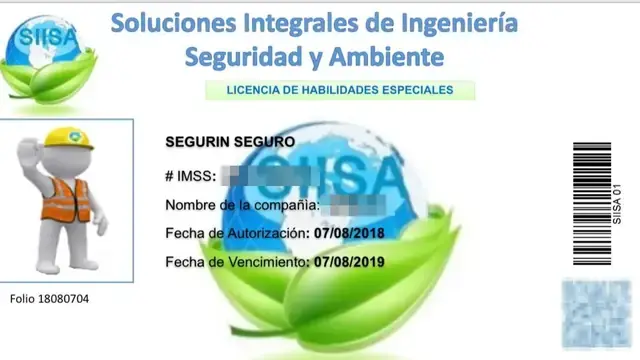
NOM-009's conformity assessment procedure accepts as training evidence the certificates of labor skills issued by internal or external training agents. In Mexico that certificate is the DC-3, the "constancia de competencias o de habilidades laborales" defined in LFT article 153-V. Format and deadlines are in our explainer on the DC-3 certificate in Mexico.
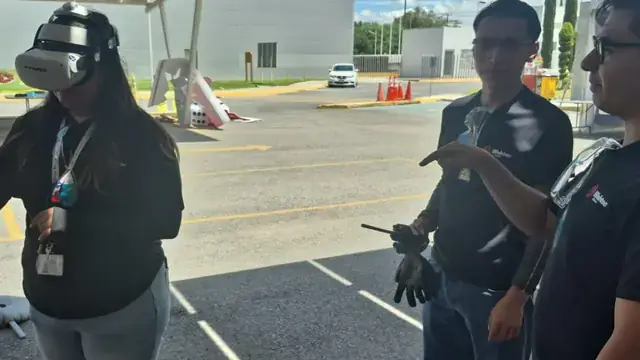
SIISA Consultores delivers work at heights training with DC-3 at the client's plant, with practice on the equipment the crew will use. SIISA delivers the DC-3 the same day the course is passed (the Training Agreement, DOF June 14, 2013, art. 24, allows up to 20 business days) and issued under the external training agent registration with the STPS of SIISA's lead instructor. SIISA holds REPSE folio 325941, valid until August 7, 2028, for industrial training.
Frequently asked questions
How often does work at heights training have to be renewed in Mexico?
NOM-009-STPS-2011 sets no refresher interval for training; chapter 16 defines content by type of equipment. The fixed deadline is the medical exam, at least once a year (section 14.1). Retraining makes sense whenever the lift model or the task changes.
Is an online DC-3 valid for work at heights?
For aerial lifts, section 16.5 requires training on the specific model, at the workplace or in similar conditions, with a practical evaluation. For harness work, section 16.2 includes rescue theory and practice, which an online-only course cannot deliver.
Who signs the DC-3 and how long does it take?
A registered external training agent signs it, or the company itself when the instructor is internal; in companies with more than 50 workers, the joint training committee (Comisión Mixta de Capacitación) authenticates it. It must be delivered within 20 business days of passing the course (Training Agreement, DOF June 14, 2013, art. 24).
How much does a work at heights course with DC-3 cost in San Luis Potosí?
SIISA Consultores' open work at heights course with DC-3 starts at MXN 1,500 per person plus IVA. In-plant group courses are quoted by group size and equipment.