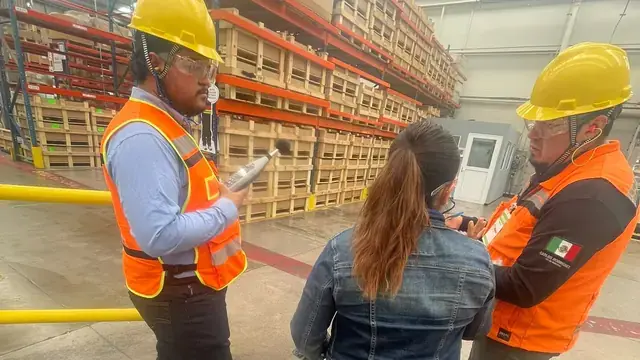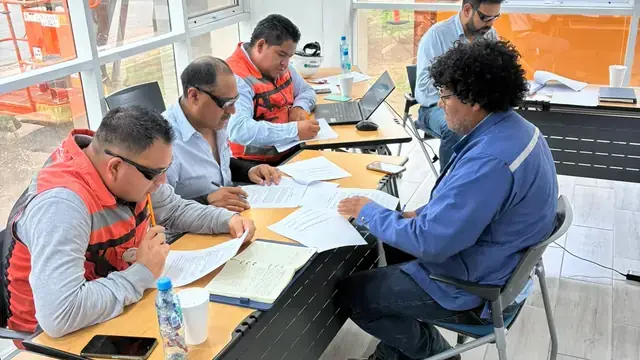
Your corporate EHS audit will ask the San Luis Potosí site for a legal register: every regulation that applies, with its current version. The first surprise for a plant manager from Michigan or Bavaria is that Mexico has no list of safety rules for auto suppliers. The STPS standards that apply to a plant in Mexico are set by what happens on the floor, and the STPS, Mexico's federal labor ministry, says so on its own standards portal. Our STPS compliance consulting team builds that register by walking the site with the table below.
Why NOMs apply by activity instead of by industry
Mexico's mandatory safety rules are Normas Oficiales Mexicanas (NOMs), published in the DOF, Mexico's Official Gazette. Each key ends in a year, so NOM-006-STPS-2023 and NOM-006-STPS-2014 are different documents, and only one of them is in force.
The STPS groups its occupational safety and health NOMs into five categories on its ASINOM portal. Safety, health and organization standards apply to any site that produces, sells, transports, stores or provides services, depending on its activities and on the raw materials, products and by-products it handles. Product standards apply to companies that make or sell fire equipment and PPE. The sector-specific ones cover agriculture, forestry, railroads, mining, construction and telework.
A manufacturing plant in Mexico builds its list of standards from its process map. The underlying duty sits in the Federal Labor Law (LFT), article 132, section XVI: install and operate the work center according to the NOMs on safety, health and the work environment.
The logic will feel familiar if you know OSHA's general industry rules, which also attach to hazards. The NOMs still set their own records, refresher periods and evidence, and the STPS inspects against those.
What STPS standards apply to every plant in Mexico?
Seven NOMs apply to every work center, whatever it makes, because their scope section says so: NOM-001-STPS-2008 (buildings and facilities), NOM-002-STPS-2010 (fire prevention), NOM-019-STPS-2011 (safety and hygiene committee), NOM-025-STPS-2008 (lighting), NOM-026-STPS-2008 (safety colors and signs), NOM-030-STPS-2009 (preventive safety services) and NOM-035-STPS-2018 (psychosocial risk factors). NOM-017-STPS-2024 joins as soon as any job requires personal protective equipment (PPE).
Those seven standards stay on the register even for a warehouse with no machinery.
STPS standards by activity: the applicability table
Keys were checked against the STPS list of standards in force on October 25, 2026. Each trigger comes from the standard's scope or definitions as published in the DOF, with the section number.
| Activity or condition | Current NOM | What triggers it |
|---|---|---|
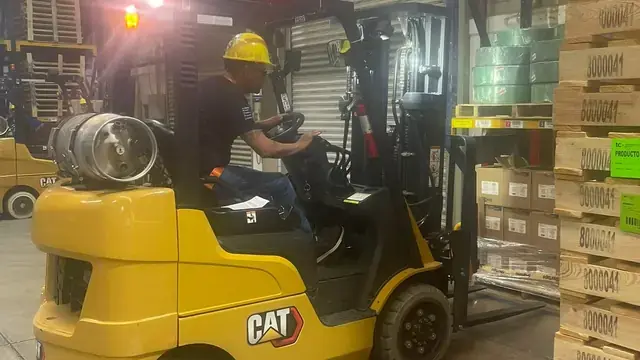
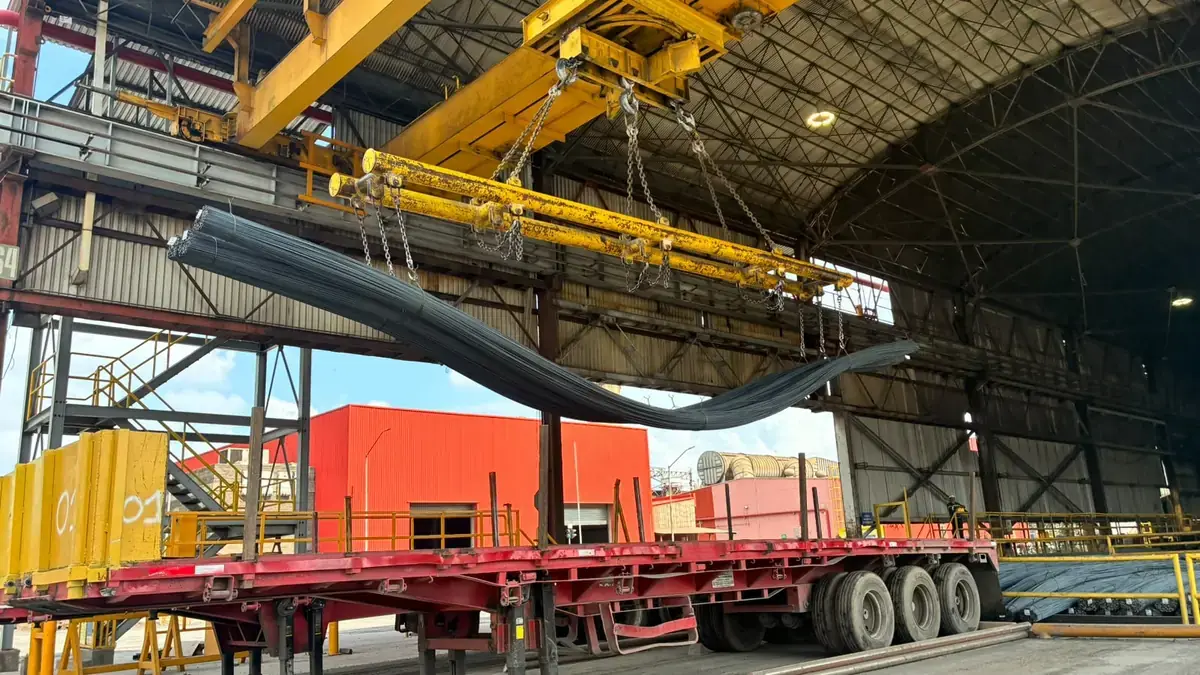
| Forklifts, cranes, hoists and conveyors | NOM-006-STPS-2023 | Storing or handling materials with machinery (2) |
| Work at height and aerial lifts | NOM-009-STPS-2011 | Tasks more than 1.80 m (about 5 ft 11 in) above the reference level (4.33) |
| Confined spaces | NOM-033-STPS-2015 | Work in spaces with poor ventilation, restricted entry and no design for continuous occupancy (4.11) |
| Hazardous chemicals | NOM-005-STPS-1998 and NOM-018-STPS-2015 | Handling, transporting or storing hazardous chemicals (2) |
| Chemical fumes, vapors or dust in the air | NOM-010-STPS-2014 | Chemical agents that contaminate the work environment (2) |
| Welding and cutting | NOM-027-STPS-2008 | Any welding or cutting (2) |
| Electrical maintenance | NOM-029-STPS-2011 | Maintenance of permanent or temporary electrical installations (2) |
| Static electricity | NOM-022-STPS-2015 | Areas with flammable or explosive substances, or processes that build up static charge (2.1) |
| Noise | NOM-011-STPS-2001 | Any noise exposure (2); hearing conservation program at 85 dB(A) and above (5.5) |
| Lighting | NOM-025-STPS-2008 | Every work center (2) |
| Fire | NOM-002-STPS-2010 | Every work center; high fire risk and fire brigades at 3,000 m² (about 32,300 sq ft) or more of built area (Appendix A and 5.6) |
| PPE | NOM-017-STPS-2024 | Jobs that require PPE (2) |
| Machinery and process equipment | NOM-004-STPS-1999 | Processes that use machinery and equipment (2) |
| Pressure vessels and boilers | NOM-020-STPS-2011 | Pressure vessels, cryogenic vessels or boilers in operation; fire extinguishers and portable gas cylinders are excluded (2.2) |
| Safety signs and pipe color codes | NOM-026-STPS-2008 | Every work center, with the exceptions in 2.2 |
| Buildings, floors, stairs and vehicle traffic | NOM-001-STPS-2008 | Every work center (2) |
| Manual handling of loads | NOM-036-1-STPS-2018 | Loads of 3 kg (about 6.6 lb) or more, handled more than once a day (2 and 2.1) |
| Psychosocial risk factors | NOM-035-STPS-2018 | Every work center, with duties by headcount (2) |
| Preventive safety services | NOM-030-STPS-2009 | Every work center (2) |
| Safety and hygiene committee | NOM-019-STPS-2011 | Every work center (2) |
Depending on the process, also check NOM-015-STPS-2001 for exposure to extreme heat or cold and NOM-024-STPS-2001 for tools or equipment that transmit vibration.
What changes at 50, 100 and 300 workers?
Headcount does not add standards to the table, but it changes how much several of them demand:
- Under NOM-030, a site with fewer than 100 workers may let the employer act as safety officer and keep a shorter list of actions (4.1.1 and 4.4.1). Above that, you need a designated officer and a full annual program.
- NOM-035 has three tiers: up to 15 workers, 16 to 50 and more than 50. The top tier adds an evaluation of the organizational environment.
- The NOM-019 committee needs a coordinator, a secretary and members from 15 workers (7.1).
- The LFT requires a joint training committee above 50 workers (art. 153-E), an infirmary under a surgeon's direction above 100 (art. 504, section II) and a hospital above 300 (section III).
In San Luis Potosí, 321 of the 448 manufacturing plants with 51 or more employees have more than 100 (INEGI, Mexico's national statistics institute, DENUE directory, May 2026). For most of those plants, none of the small-site shortcuts in NOM-030 or NOM-035 are available. Our guide to the safety officer role under NOM-030 covers who can hold it.
Standards replaced since 2024 and those under review
Two keys changed recently, and older corporate templates may still carry the previous versions. NOM-006-STPS-2023 (DOF, March 7, 2024) took effect on September 3, 2024 and voided NOM-006-STPS-2014; our guide to Mexico's forklift standard compares both texts. NOM-017-STPS-2024 (DOF, March 28, 2025) took effect on September 28, 2025 and replaced the 2008 PPE standard.
Four more sit in the 2026 standardization program and remain in force as written. The National Quality Infrastructure Program 2026 (DOF, February 24, 2026) lists changes to NOM-005-STPS-1998 (chemicals) and NOM-011-STPS-2001 (noise) and keeps the PROY-NOM-004-STPS-2020 machinery draft; its supplement (DOF, August 26, 2026) adds NOM-002-STPS-2010 (fire). Until a new version is published in the DOF, inspectors audit against the one in force.
How do you keep the legal register inspection-ready?
Start with the STPS's own tool, the ASINOM assistant for identifying applicable standards. The interface is in Spanish. It asks for your economic activity as classified in the work risk catalog of the IMSS (Mexican Social Security Institute), then up to 44 questions, about 20 minutes with the data at hand: building height, total occupants, built area, the inventory of flammable and combustible gases, liquids and solids, and the name or CAS number of each chemical. It returns the applicable NOMs and the specific sections the site must meet. You can enter with or without registering, and the STPS warns that the result depends on the accuracy of your answers.
The list then needs a home an inspector can follow. NOM-030-STPS-2009 requires the safety and health diagnosis to identify the applicable regulatory requirements (section 6.1 d) and the program to give each finding an action, dates and an owner (7.1). Each line of the register needs its evidence filed behind it, in the form the NOM asks for.
Training is where many lines come due. Refreshers run at least yearly for confined spaces (NOM-033, 11.6), hazardous chemicals (NOM-018, 11.1) and welding (NOM-027, 5.6), and at least every two years for forklifts (NOM-006, 10.4), PPE (NOM-017, 5.9) and manual handling (NOM-036-1, 10.3). The evidence is the DC-3, Mexico's certificate of job skills, which our DC-3 safety training delivers at your plant.
Gaps are fined per standard and per person: 250 to 5,000 UMA, Mexico's daily unit for fines, per affected worker, or MXN 29,327.50 to MXN 586,550 at the 2026 UMA of MXN 117.31 (LFT arts. 992 and 994). Our guide to STPS fines in Mexico shows how they add up. The STPS scheduled 38,455 inspections for 2026 (Bulletin 105/2026).
Frequently asked questions
Is there an official list of STPS standards for automotive plants?
No. The STPS only issues sector-specific standards for agriculture, forestry, railroads, mining, construction and telework. A manufacturing plant applies the safety, health and organization NOMs that match its activities and materials, and the STPS ASINOM assistant helps identify them.
Does an OSHA-based EHS program meet Mexican NOM requirements?
It is a useful starting point, because both systems attach rules to hazards, but the STPS inspects against the NOMs. Each NOM sets its own records and refresher periods, and inspectors expect Mexican evidence such as DC-3 training certificates and the NOM-030 diagnosis and program.
Which forklift standard is in force in Mexico?
NOM-006-STPS-2023, published in the DOF on March 7, 2024 and in force since September 3, 2024. It voided NOM-006-STPS-2014, so procedures, operator authorizations and training records should cite the 2023 version.
Who decides which STPS standards apply to my plant?
The employer does, through the safety and health diagnosis required by NOM-030-STPS-2009, which must identify the applicable regulatory requirements (section 6.1). An internal or external safety officer prepares it, and STPS inspectors check it.