One hundred workers. Below that headcount, NOM-030-STPS-2009 lets the employer act as its own safety officer and swap the annual program for a shorter list of preventive and corrective actions. At 100 and above, someone has to be formally designated, and once a site passes 100, Mexico's Federal Labor Law also requires an infirmary. For an EHS manager arriving in San Luis Potosí from Ohio or Bavaria, the safety officer role in Mexico looks familiar. The paperwork behind it, and the rules for staffing it through a contractor, are distinctly Mexican.
What does NOM-030 require from a safety officer in Mexico?
Section 4.1 of NOM-030-STPS-2009, published in the DOF (Mexico's Official Gazette) on December 22, 2009, requires the employer to designate a "responsable de seguridad y salud en el trabajo", internal or external, to carry out the preventive functions listed in chapter 5. The standard also allows a mixed model (3.15).
In Mexico the safety officer is a formal designation with duties set by the standard, and the role has to stay filled even when the person changes. When an inspector from the STPS, Mexico's federal labor ministry, checks section 4.1, the accepted evidence is an appointment letter for an internal or mixed officer, or a services contract for an external one.
The employer must give the officer access to every area, information on processes and jobs, and the means to put safety measures in place (4.2), and the appointment document must spell that out when the officer is not the employer.
The diagnosis and annual program behind the title
Of the nine duties in chapter 5, the ones that drive the workload are the safety and health diagnosis (5.1), a program prioritized by risk (5.2) and follow-up, with a written report to the employer at least once a year (5.7).
The diagnosis (chapter 6) identifies unsafe physical conditions in facilities, machinery, equipment and energy sources; physical, chemical and biological agents; hazards around the site, where possible; and every Mexican regulation that applies. Since October 2020 it also absorbs the psychosocial risk results required by NOM-035-STPS-2018, which we cover in NOM-035 compliance by headcount.
The program (7.1) assigns each finding a preventive or corrective action, start and end dates and an owner, and adds health promotion and emergency response. It is updated at least once a year (4.4) and shared with the joint safety and health committee or the workforce (4.5). If compliance is checked by interview, 90% of the workers interviewed must know the diagnosis and the program.
If you already run a corporate EHS management system, the fastest route is to map its risk assessment and action plan onto the NOM-030 diagnosis and program, with section references an inspector can follow. Records must be kept for at least two years (4.8).
Can the employer be its own safety officer?
Yes, at work centers with fewer than 100 workers (4.1.1). The inspector confirms it by interview. Those sites may replace the full program with a list of preventive and corrective actions updated yearly (4.4.1), and their diagnosis can cover, at minimum, the applicable regulations (6.2).
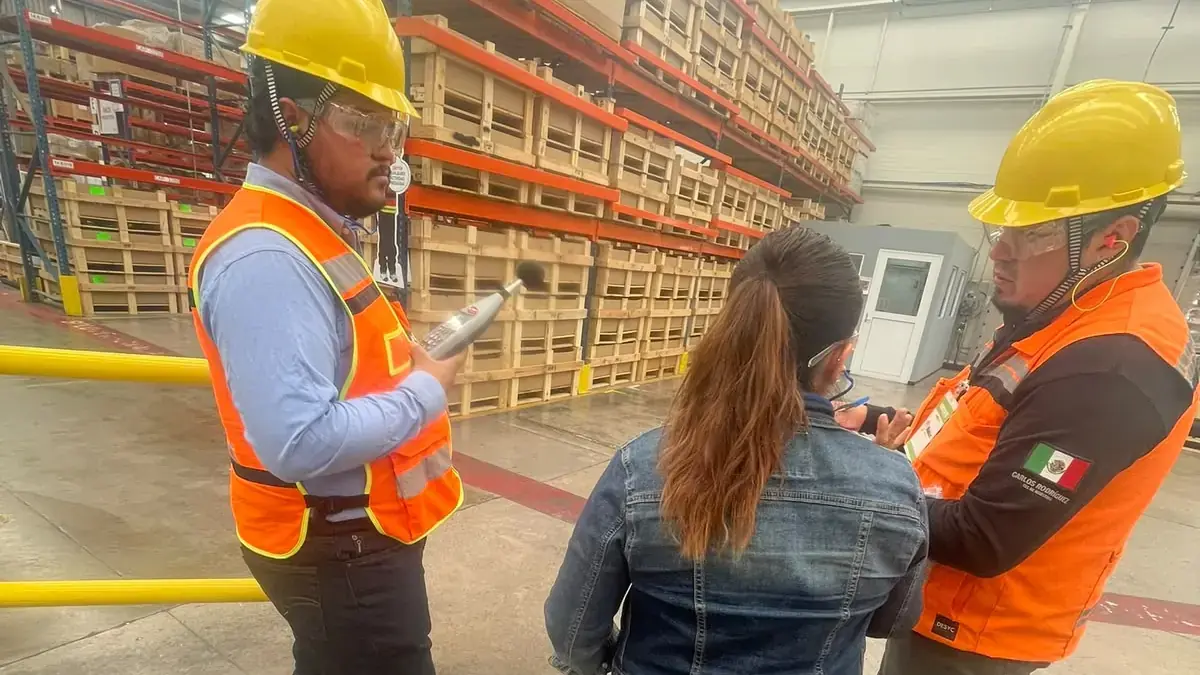
For a small site, though, the plant manager rarely has the hours to do it well. A small site can contract the preventive services externally and comply without adding a full-time position. An external officer prepares the diagnosis and action list, visits on an agreed schedule and delivers the annual report.
Above 100 workers: infirmary, doctor and floor supervisor
Article 504 of the Federal Labor Law (LFT) adds medical obligations as headcount grows. Every employer must keep first aid supplies and train staff to use them (section I). With more than 100 workers, the employer must set up an infirmary staffed by competent personnel under the direction of a surgeon (section II). With more than 300, a hospital with medical and support staff (section III). Section IV allows the employer, with the workers' agreement, to cover the last two through contracts with nearby clinics or hospitals.
In San Luis Potosí, 321 of the 448 manufacturing plants with 51 or more employees have more than 100 (sum of the 101 to 250 and 251-plus brackets; INEGI, Mexico's national statistics institute, DENUE directory, May 2026). Their infirmaries see a specific case mix: 70% of occupational diseases in the state in 2025 were shoulder injuries, carpal tunnel syndrome and tenosynovitis (IMSS, the Mexican Social Security Institute, Statistical Report 2025, table VII.27).
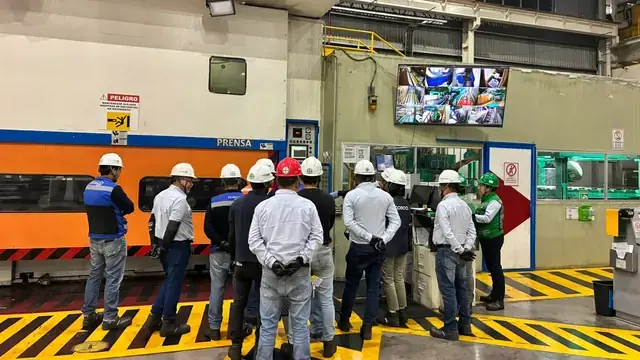
NOM-030 does not require a safety supervisor on every shift. In industry practice, mid-size and large plants usually keep one on the floor anyway, someone who walks the lines, checks work permits, investigates incidents and feeds the program the safety officer signs.
What happens when your safety supervisor quits?
Turnover is the recurring problem. Safety supervisors, plant nurses and plant doctors move between employers, and each departure leaves a gap in floor rounds, in program follow-up and, if that person held the designation, in the appointment an inspector asks for.
Turnover hits the operator side too. Nationwide, 48.2% of workplace accidents and occupational diseases happen to people with less than one year in the job (IMSS, Statistical Report 2025, table VII.12). A plant that hires heavily needs more onboarding and more safety presence on the floor.
That is the gap SIISA covers with in-plant safety staff: SIISA places the safety supervisor, the nurse or the doctor at your plant. That person follows your policies and procedures and reports to you, and recruiting a replacement stops landing on your EHS team.
Outsourcing safety staff after Mexico's 2021 reform
If you are used to filling a safety technician role through a staffing agency, Mexico works differently. Since the April 2021 reform, the LFT prohibits subcontracting personnel (art. 12). It only allows specialized services that are not part of the client's corporate purpose or main economic activity, delivered by a contractor listed in the STPS public registry of specialized service providers, known as REPSE (art. 13). The contract must be in writing, and the client is jointly liable if the provider fails its own workers (art. 14). Registration is renewed every three years (art. 15).
Before a contractor puts people inside your plant, check that the activity in its REPSE registration matches the service you are buying. Subcontracting without registration carries fines of 2,000 to 50,000 UMA, Mexico's daily unit for fines: MXN 234,620 to MXN 5,865,500 with the 2026 UMA of MXN 117.31, and the same fine applies to the company that benefits (LFT art. 1004-C). Our guide to STPS fines in Mexico puts these amounts in context. For the diagnosis and program themselves, see STPS compliance consulting.
Frequently asked questions
Can the NOM-030 safety officer be an external consultant?
Yes. Section 4.1 of NOM-030-STPS-2009 allows an internal or external safety and health officer, and the standard also recognizes a mixed model. For an external officer, the services contract is the evidence an STPS inspector accepts.
What NOM-030 documents does an STPS inspector ask for?
The officer's appointment letter or contract, the safety and health diagnosis, the program or list of actions updated at least once a year, and the follow-up reports. Records must be kept for at least two years.
When does a plant in Mexico need an infirmary?
Article 504 of the Federal Labor Law requires an infirmary, staffed by competent personnel under a surgeon's direction, once the employer has more than 100 workers, and a hospital above 300. With the workers' agreement, those services can be covered through contracts with nearby clinics or hospitals.
Does an in-plant safety provider need REPSE registration?
Yes, a provider that delivers specialized services with its own staff at your facility must be registered in REPSE for that activity (LFT arts. 13 to 15). Without it, the fine of 2,000 to 50,000 UMA applies to both the provider and the client.