A hearing conservation policy written around OSHA's 29 CFR 1910.95 gives a worker 4 hours at 95 dBA. In a Mexican plant, 4 hours is the allowance at 93 dB(A). Noise exposure limits in Mexico come from NOM-011-STPS-2001, a mandatory standard (NOM, Norma Oficial Mexicana) issued by the STPS, Mexico's federal labor ministry, and it applies to every work center where workers are exposed to noise (section 2). For plants in San Luis Potosí, SIISA runs noise and lighting studies with an allied laboratory as part of its STPS compliance consulting.
Is NOM-011-STPS-2001 still in force in 2026?
Yes. It was published in the DOF (Mexico's Official Gazette) on April 17, 2002, took effect on June 16, 2002, and replaced the 1993 version. PLATIICA, the Ministry of Economy's catalog of standards, lists it as in force, with a systematic review dated January 23, 2023 that ended in "confirmation".
The 2026 National Quality Infrastructure Program (DOF, February 24, 2026) lists an amendment for the first time, with an estimated January to December 2026 schedule; its rationale mentions reviewing the limits and taking a closer look at hearing protection. As of October 30, 2026, PLATIICA's list of drafts open for public comment includes no NOM-011 draft. Until a new version is published in the DOF, plants comply with the 2002 text and inspectors audit against it.
Two references inside the standard are out of date. Personal protective equipment (5.4) now falls under NOM-017-STPS-2024, published March 28, 2025, and safety signs (8.7.4) under NOM-026-STPS-2008, both in force according to PLATIICA.
Noise exposure limits in Mexico, hour by hour
The limit is expressed as the noise exposure level (NER, nivel de exposición a ruido), the average A-weighted level referred to 8 hours (4.1.18). Appendix A pairs each NER with a maximum permissible exposure time:
| NER | Maximum exposure time |
|---|---|
| 90 dB(A) | 8 hours |
| 93 dB(A) | 4 hours |
| 96 dB(A) | 2 hours |
| 99 dB(A) | 1 hour |
| 102 dB(A) | 30 minutes |
| 105 dB(A) | 15 minutes |
The exchange rate is 3 dB(A): every 3 dB more halves the allowed time (4.1.40), and section 7.2 gives the equation for levels between rows. No one may be exposed above 105 dB(A) without hearing protection (5.3), and an NER above 105 dB(A) requires engineering controls (7.3).
The duties start below the limit:
| Level | What it triggers | Section |
|---|---|---|
| 80 dB(A) | Noise survey of areas with workers; at an NER of 80 or more, periodic resurvey and training | 5.2, 8.2.2 and 8.5.1 |
| 85 dB(A) | Hearing protection, hearing conservation program, yearly medical exam and a mandatory-protection sign at the area entrance | 5.4, 5.5, 8.6 and 8.7.4 |
| 90 dB(A) | Limit for an 8-hour shift | Table A.1 |
| 105 dB(A) | No one without hearing protection; above that NER, engineering controls | 5.3 and 7.3 |
Where Mexico's noise rules differ from OSHA's
NOM-011 lists OSHA 1910.95 in its own bibliography, so the structure will look familiar. The numbers to audit against are Mexican. OSHA's Table G-16 pairs 90 dBA with 8 hours, 95 with 4 and 100 with 2; Mexico reaches 2 hours at 96 dB(A) and caps exposure at 105 dB(A) for 15 minutes. OSHA requires a hearing conservation program at an 8-hour time-weighted average of 85 dBA, with a baseline audiogram within 6 months of first exposure and a new audiogram at least yearly.
Mexico keeps 85 dB(A) as the trigger for protection and the program, but the survey and the training duty start at 80. Recordkeeping differs too: OSHA keeps noise exposure measurements for two years and audiometric records for the duration of employment, while NOM-011 asks for the program documentation with the last 5 years of information (8.8.1). A global standard tuned to OSHA needs a Mexican annex with the 3 dB table and the 80 dB(A) survey trigger.
What must a NOM-011 noise survey include?
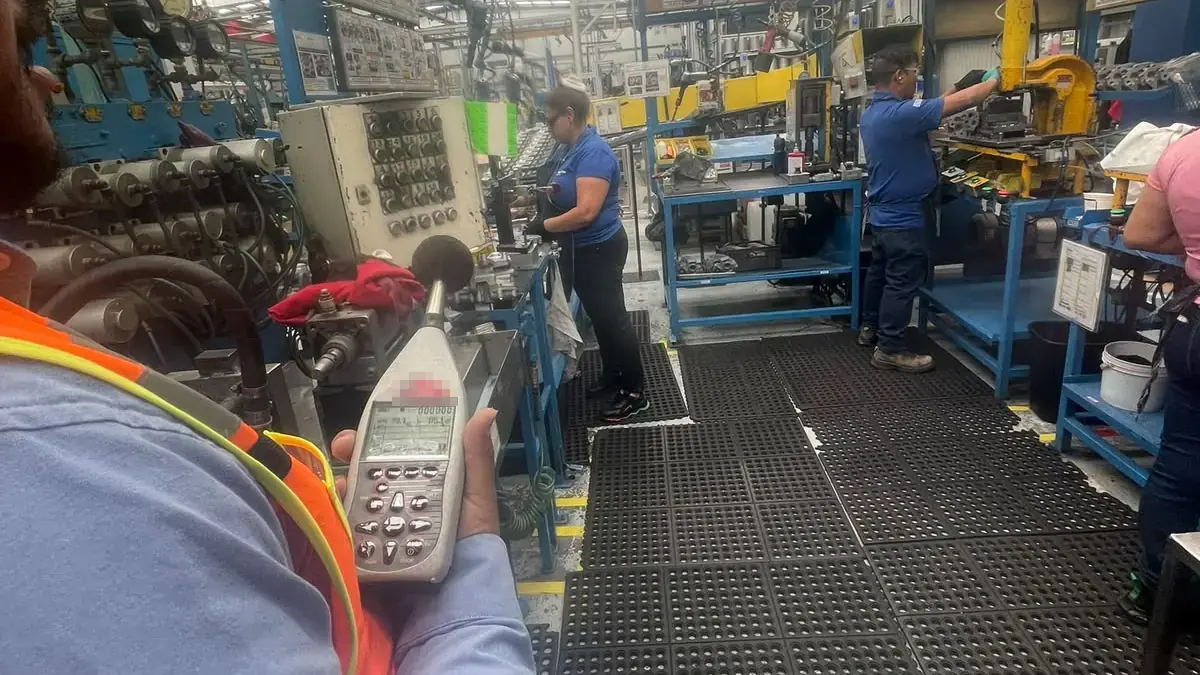
The survey has two parts. The recognition (8.2.1 and B.4) is a walk-through with a sound level meter that gathers floor plans of noisy areas and machinery, the process, the job positions, maintenance programs, production records, the number of exposed workers per area with their exposure time, and whether the noise is steady, unsteady or impulsive.
The evaluation follows Appendix B:
- It runs under normal operating conditions for at least one full 8-hour shift, the one with the highest noise emission (B.5.1 and B.5.2).
- It uses a class 1 or class 2 sound level meter, integrating meter or personal noise dosimeter (B.2), field-calibrated at the start and end of the day; a difference of 1 dB or more voids that day's readings (B.3.2).
- Area methods set points no more than 12 m apart (B.6.2) or grids of no more than 6 m per side (B.6.3); at fixed workstations the microphone sits at 1.45 ± 0.10 m for standing work (B.6.4.2).
- Dosimeters go on the middle of the shoulder, set to a 90 dB(A) criterion and a 3 dB(A) exchange rate, for at least 5 hours (B.6.8).
- Where levels reach 80 dB(A), octave-band sound pressure levels from 31.5 to 8,000 Hz are measured as well (8.3 and Appendix C).
The record (B.7) includes the operating conditions, the method criteria, a plan with the measurement points, the field sheets, the NER calculations, a copy of the instrument's calibration document and the name and signature of the person responsible; the octave-band record adds that person's professional license number, the cédula profesional (C.7 f). Ask your vendor for the octave-band data, because section 5.2 requires the frequency components and not just the dB(A) figures.
How often must the survey be repeated, and by whom?
Where exposure equals or exceeds an NER of 80 dB(A), the survey is repeated every two years, or within 90 days of a change in production, processes, equipment, controls or anything else that could change the results (8.2.2 d); the octave-band survey follows the same rule (8.3.1.2 c). Each control measure needs a new evaluation within 30 days to confirm it works (8.7.2). A line transfer or a new press resets the clock to 90 days, whatever your two-year calendar says.
The employer may choose to hire an accredited and approved verification unit or testing laboratory (10.1). Laboratories may run the survey (10.2); verification units check sections 5.2 to 5.8 and issue a dictamen, a verification report (10.3), and both reports are valid for two years unless machinery, equipment, layout or operating conditions change (10.5). Instrument calibration is not optional: an accredited calibration laboratory checks the meters periodically, and a copy of the calibration document goes into the record (B.3.1 and B.7 f).
Hearing conservation and audiometry in Mexico
The program applies wherever workers are exposed to 85 dB(A) or more (5.5) and has seven elements: NER evaluation, octave-band evaluation, hearing protection, training, health surveillance, controls and documentation (8.1). Protectors are rated with the reduction factor of Appendix D, by octave bands or with the manufacturer's NRR, and must be certified or carry the manufacturer's attenuation guarantee (8.4.1); the plant needs written procedures for selection, training and supervision (8.4.3). Our guide to NOM-017-STPS-2024, Mexico's PPE standard covers the selection side. Training covers workers at an NER of 80 dB(A) or more (8.5.1), and SIISA's DC-3 training catalog includes an occupational noise course.
When the NER exceeds Table A.1, the plant applies controls: maintenance of noise sources, equipment substitution, enclosures, barriers, machine isolation, or administrative limits on exposure time (8.7.1), each backed by a written technical analysis (8.7.2).
Section 8.6 requires a specific medical exam every year for each worker at 85 dB(A) or more, following Ministry of Health standards or, where none exist, the company physician's criteria. It allows the use of Reference Guide I, which the standard labels non-mandatory. The guide proposes a baseline audiogram for each worker assigned where the NER exceeds 85 dB(A), after at least 14 hours without noise at work (I.3 a), and verification audiograms every six months at 85 dB(A) or more and yearly between 80 and 85 (I.3 b). A plant that adopts the Mexican guide tests high-noise areas twice as often as OSHA's yearly audiogram. SIISA coordinates audiometry through an allied licensed physician in its occupational health service, and our guide to pre-employment medical exams in Mexico explains where the baseline fits in hiring.
Records, inspections and fines under NOM-011
NOM-011 has no conformity assessment chapter. Its inspection rule is section 5.1: show the labor authority, on request, the documents the standard requires, with enforcement assigned to the STPS (chapter 11). The file holds seven records (8.8.3): noise and octave-band studies, hearing protection and its procedures, training, health surveillance, control measures with their follow-up evaluation, conclusions, and the documents that support sections 5.2 and 5.7. The sign at each 85 dB(A) entrance (8.7.4) and protector use inside (8.4.4) are visible on a walk-through. Our guide to STPS inspections in Mexico explains how a visit runs.
Failing to observe safety and health standards carries fines of 250 to 5,000 UMA, Mexico's daily unit for fines, per affected worker: MXN 29,327.50 to MXN 586,550 with the UMA of MXN 117.31 in force since February 1, 2026 (Federal Labor Law, LFT, arts. 992 and 994, section V), doubled for repeat violations. Our guide to STPS fines in Mexico shows how those amounts add up, and the NOM-025 lighting guide covers the survey that is often quoted together with noise.
Frequently asked questions
What is the legal noise limit for an 8-hour shift in Mexico?
A noise exposure level of 90 dB(A), under Table A.1 of NOM-011-STPS-2001. The allowed time halves every 3 dB: 4 hours at 93 dB(A), 2 at 96 and 15 minutes at 105. No one may be exposed above 105 dB(A) without hearing protection (section 5.3).
At what level must a Mexican plant provide hearing protection?
At 85 dB(A). NOM-011-STPS-2001 requires hearing protection for every worker exposed at or above that level (section 5.4), a mandatory-protection sign at the area entrance (8.7.4) and a hearing conservation program in those areas (5.5).
Does a NOM-011 noise survey need an accredited laboratory?
No. Hiring an accredited and approved testing laboratory or verification unit is the employer's choice (section 10.1). The instruments, however, need periodic calibration by an accredited calibration laboratory, with a copy of the calibration document in the survey record (B.3.1 and B.7).
How often do workers in noisy areas need audiograms in Mexico?
NOM-011-STPS-2001 requires a specific medical exam every year for each worker at 85 dB(A) or more (section 8.6). Its non-mandatory Reference Guide I proposes a baseline audiogram and verification audiograms every six months at 85 dB(A) or more and yearly between 80 and 85 dB(A).
Official sources
- NOM-011-STPS-2001, safety and health conditions in workplaces where noise is generated (DOF 17/04/2002)
- NOM-011-STPS-2001 record in PLATIICA, Ministry of Economy
- 2026 National Quality Infrastructure Program (DOF 24/02/2026)
- Draft standards open for public comment, PLATIICA
- NOM-017-STPS-2024 record in PLATIICA
- NOM-026-STPS-2008 record in PLATIICA
- Federal Labor Law, last amended DOF 14/05/2026
- 2026 UMA value (DOF 09/01/2026)
Every figure in this guide comes from these texts. If you find one out of date, write to us at comercial@siisaconsultores.com.